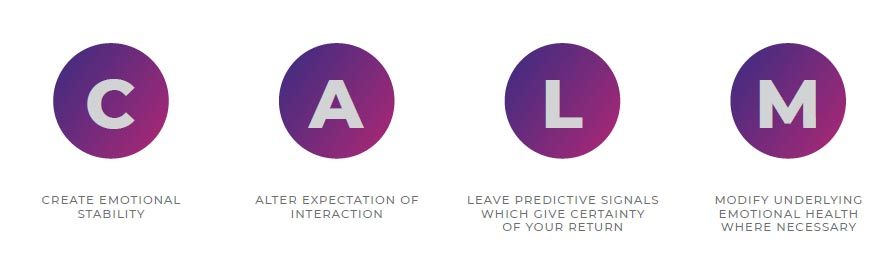
The CALM® programme has been created by RCVS and EBVS® European Veterinary Specialist in Behavioural Medicine, Dr Sarah Heath BVSc PgCertVE
Dip. ECAWBM(BM) CCAB FHEA FRCVS.
The CALM programme helps both prevention and management of separation-related behaviour, in 4 steps.
Behaviour modification is an important part of managing separation-related disorders in dogs. A traditional approach for behaviour modification for these dogs was based around reducing predictability of departure. But we now know the importance of predictability and control, which has led to a different approach to separation problems, where dogs are given a clear signal of intended departure.
These new ways of thinking about management of separation-related behaviours have been incorporated into the CALM® programme. The CALM® programme is a 4 step approach that has been created to help the caregiver prevent and manage separation-related disorders in their dog.
Behaviour modification is an important part of managing separation-related disorders in dogs. A traditional approach for behaviour modification for these dogs was based around reducing predictability of departure. But we now know the importance of predictability and control, which has led to a different approach to separation problems, where dogs are given a clear signal of intended departure. These new ways of thinking about management of separation-related behaviours have been incorporated into the CALM® programme. The CALM® programme is a 4 step approach that has been created to help the caregiver prevent and manage separation-related disorders in their dog.
C | CREATE EMOTIONAL STABILITY
Consider the dog’s behaviour when they are not alone – being able to control their emotions helps them to cope with periods of solitude.
Anxiety is linked to low self-confidence. Work to increase the dog’s ability to make decisions for themselves and to cope with novelty and change as this helps to reduce their risk of anxiety.
Reward the dog for making good decisions and set them up to be successful. The caregiver can do this through encouraging the dog to play with toys on their own and through rewarding calm and settled behaviour.
Remember the caregiver should avoid interactions with the dog which they could perceive as being confrontational – avoid loud stern voices and do not punish behaviour that has happened in their absence.
A | ALTER EXPECTATION OF INTERACTION
We love to share our dog’s company and there is a temptation to spend every minute together when they are home. This can lead to unrealistic expectations of company and make the dog reliant on their caregiver to make them feel safe.
When puppies are very young it is important for them to spend some time alone with appropriate toys to keep them happy and occupied.
When dogs are uncertain they look for information and often try to obtain it from humans through behaviours such as leaning, pawing, nudging, sniffing and licking. If they become dependent on this information they are more likely to be anxious when their caregiver is not available.
Never reject or ignore these requests for help but respond in a calm and passive manner so that they help their dog to overcome their uncertainty.
Anxious dogs will also offer information through rolling on their back or dribbling urine.
Caregivers should not encourage information seeking or offering behaviours but reward their dog when they start to become more confident, such as when they stop licking their hand or the dog gets up after rolling on their back.
L | LEAVE PREDICTIVE SIGNALS WHICH GIVE CERTAINTY OF YOUR RETURN
Predictability and control help to reduce anxiety so it is important to enable the dog to predict the caregiver’s departure and return.
The caregiver should provide a visual signal that they are not available and remove this signal when they return.
Introduce this signal to the dog slowly and carefully using short periods of planned departure in a safe, comfortable and relaxing location. When the caregiver returns they should remove the signal before interacting with their dog.
If the dog is already distressed when they leave it is helpful to minimise the times when this is necessary if possible.
If the dog must be left, the caregiver should select a different location from the training safe place and leave a different visual signal.
M | MODIFY UNDERLYING EMOTIONAL HEALTH WHERE NECESSARY
Altering the dog’s neurochemistry and increasing availability of serotonin, for example by using Reconcile®, can help to reduce anxiety.
Medication is only one part of the approach and must be used in conjunction with a behavioural modification programme.